Transcript
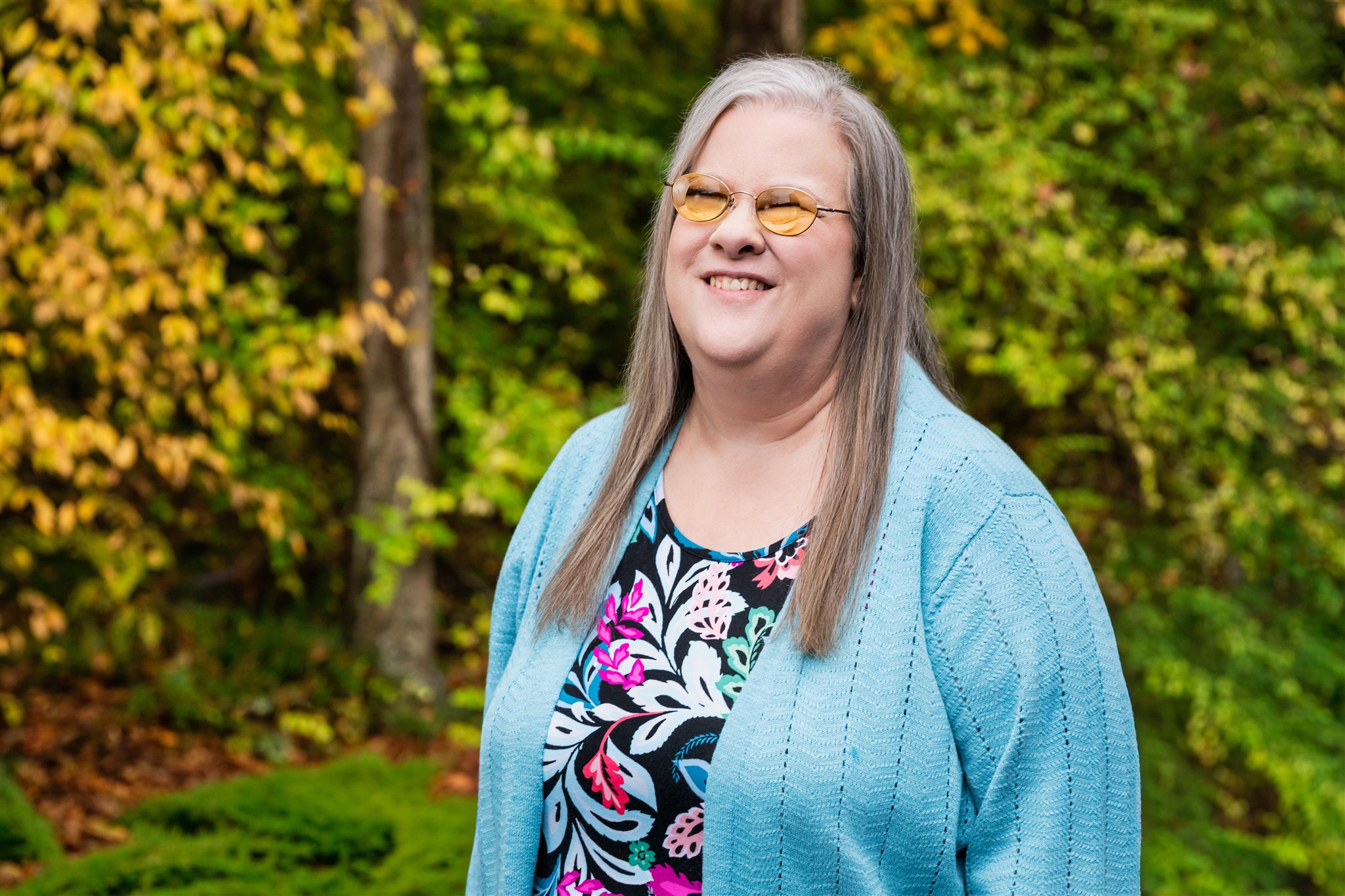
Hi. My name is SarahBlake LaRose. I graduated from Anderson University School of Theology in 2009 with professional distinction in Hebrew. It was a long journey for me to get there, and I want to tell you some of the back story.
In 1992, I was an undergraduate student at Anderson University in the Christian ministries department. I was the first blind student that AU had had in quite a while, and things were a lot different than than they are now. Now, as a blind person, I can take a book out of the library, take it home, put it on a scanner… I have to turn every page, but I don’t view that as an imposition because sighted people also have to turn every page. I can read a book on my own. But then, I had to hire people to read books to me. I didn’t have much money, so I didn’t do much reading.
At heart, I loved to read. If I could have, I would have spent a lot of time in the library, reading and reading and reading and browsing, getting into the journal databases… I probably never would have left! But I couldn’t do it.
A lot of my classmates took Hebrew and Greek. I was very curious about these classes because I loved languages. I took French in high school, and I loved French so much! In college, I tried taking Spanish, and I loved that too. I took four semesters of that. But I couldn’t take Hebrew and Greek because as far as I knew, Hebrew and Greek couldn’t be put into braille.
When I did research papers for my classes and my friends had to read to me from commentaries, I found out that my friends weren’t so good at reading Hebrew and Greek. They’d start reading from the commentaries, and my friends would get to a Hebrew or Greek word, and they’d say, “Oh, that’s Hebrew or Greek. Let’s go on.” I never found out what those words were, and I felt like I was missing something from the commentaries.
Eventually, I transferred out of AU. I went to another school, and I majored in psychology. I got a minor in special education. But my heart for ministry was still beating. After I graduated, I had a really hard time deciding what I wanted to do about graduate school because I had a really strong interest in counseling but I also still wanted to study ministry. But in order to do ministry, I felt that I needed that biblical language background, and I couldn’t get it.
In 1998, my family moved from Texas to Anderson, and I moved right along with them, which meant that I was back near the university, back near that library full of old books, back near all that Hebrew. I couldn’t stand it! I wanted to learn that language so bad! But I didn’t know how to do it.
In 2001, I got a nice break. I received an email from someone who was giving away a braille Hebrew Bible. I asked her if she would send it to me. She said, “Certainly.”
A few days later, five gigantic boxes arrived on my porch.
She said that a braille manual was included with it, and I stupidly thought that I could use it to learn to read Hebrew. Boy, was I in for a big surprise! I opened up the manual, and I couldn’t rread it!
I didn’t realize that braille Hebrew, like print Hebrew, represented an entirely different alphabet system. It looked like gibberish to me.
Braille is formed by combining just six dots. Braille is not a language on its own. It is a writing system that is used to represent whatever language is being written. For instance, Spanish, French and English use the same alphabets. So, for the most part, the same braille systems are used. There are a few differences because Spanish and French use accented letters that are not used in English. So we use different braille symbols to represent those letters.
English allows the use of contractions, which means that one braille symbol might be used to represent two or three different letters. So, for instance, the symbol that represents an accented e in French represents e and d in English.
Hebrew is a completely different language with a completely different alphabet system. Some of the consonants are the same because braille has such a limited character set. But this is not the same thing as transliteration which means that we use English characters to represent the sounds of a language. It is simply an overlap between the usage of braille symbols. Not only would I need a grammar to teach me the language itself, but I would need a grammar to teach me how to pronounce these symbols! And I didn’t know where to get one.
But my heart still beat.
The Hebrew boxes went under the bed.
A couple of years later, I moved to Florida. The Hebrew boxes went with me–and under the bed.
Two years later, I moved back to Indiana. The Hebrew boxes came with me–anad went under the bed.
My dad said, “Why don’t you get rid of that? You’re never going to learn it!”
I said, “Oh, yes I am. I don’t know how I’m going to do it, but I am.”
Over the next year, I began to think about going to seminary. I wasn’t sure how I was going to do it. They have Hebrew classes there, and I wasn’t going to get out of seminary without learning Hebrew. This was my determination.
I started to interview blind people who had gone to seminary. One of them asked me, “Why do you wnat to learn Hebrew?” I said, “Because I want to read the Hebrew Bible.” He said, “That’s not a good enough readon.”
I became rebellious, and I thought, “Yes, it is!” And I became determined that I would find a way.
He said, “You’ll probably have to be smarter than everyone else in the class, and you’re probably not.”
I decided that I would learn Greek, too.
I enrolled in seminary. I decided that I would not take Hebrew right away. I needed time to adjust and time to plan.
In the summer of 2007, I began to study Hebrew. It was a more rewarding experience than I knew how to put in words. t was also very difficult. I had to configure my computer to display Hebrew on a braille display, and it wasn’t perfect.
After graduating in 2009, I worked with an organization to digitize a Hebrew grammar in braille. This meant that more students could take advantage of the opportunity to study Hebrew.
In 2015, I was hired as an adjunct professor to teach Hebrew classes online at Anderson University. Most of my students were sighted. A very few were blind. Eventually, I also taught Greek as well.
I enjoyed teaching languages, but mostly I enjoyed witnessing students’ joy as they learned languages and studied the Bible more deeply. What I would say today is that if someone wants to learn languages, there is always a way. Don’t give up. Keep seeking, and you will find the right person to work with you, and you will find hte right method that works for you.